


How to Store Suits Long-Term: Covers vs Bags for Wardrobe Storage
The suit that dies in storage is not the one worn every week. It is the good one, hung in the back of the wardrobe in a plastic bag from the dry cleaner, forgotten for a year.
We make the bags this suit should have been in. After fifteen years of shipping covers to hotels, suit brands, and uniform buyers, here is what we tell customers about long-term storage.
What actually ruins a stored suit
Four enemies, in order of damage:
- Humidity. Above 60% relative humidity, wool absorbs moisture, the fibers swell, and the shape goes. Below 40%, the fabric dries and cracks at the fold points.
- Moths. They lay eggs in the dark, undisturbed folds of a wool jacket. The larvae eat protein fibers — wool is dinner.
- Dust. It grinds into the weave and dulls the cloth. A cover is a dust barrier, nothing more and nothing less.
- Creasing. A jacket folded in a suitcase for a season comes out with a crease that needs professional pressing.
Notice what is not on the list: air itself. Fabric needs air. The storage decision is really about how much air you give the suit.
Dust cover vs sealed bag: the difference
A closet dust cover is a breathable shell. A sealed bag is a barrier. They solve different problems.
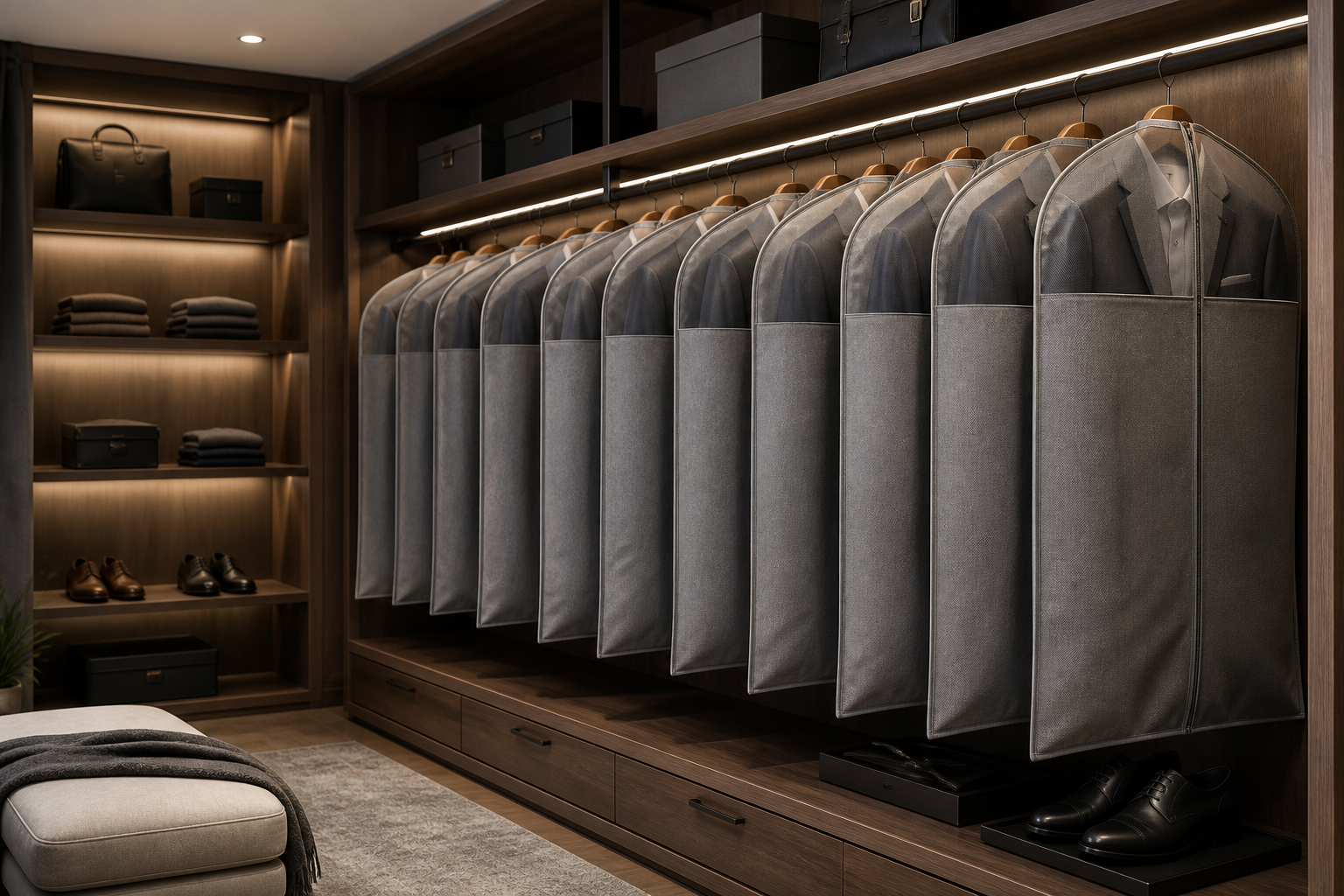
Use a breathable cover for anything stored longer than two weeks. The fabric exhales — moisture from the wool escapes, and the microclimate inside stays close to the room. We build our covers at 80-100gsm nonwoven, which keeps dust out and lets air move.
Use a sealed bag for short transport only: a car trip, a flight, a week in a hotel closet. A sealed PEVA bag traps whatever moisture is inside. In a humid climate, that means condensation on the lapels by day three.
We shipped sealed bags three years ago to a hotel in a coastal city. The suits inside are fine, because the rooms run dry air conditioning. The hotel stopped buying sealed bags anyway, after one humid summer.
Nonwoven weight: 60 vs 80 vs 100gsm
This is the number buyers skip, and it is the whole story:
| Grammage | What it is for | What it does |
|---|---|---|
| 60gsm | Home closet, light dust | Cheap, see-through, tears at the seam |
| 80gsm | Retail and hotels | Blocks dust, holds a print, decent life |
| 100gsm | Long-term storage, export | Stiff enough to hang straight, resists punctures |
For a suit you plan to store for a season or longer, do not go below 80gsm. At 60gsm the cover folds in on itself and the zipper drags on the shoulder pads.
Our recommendation for hotel uniform programs: 100gsm white or navy, with the hotel name printed. It survives 50-80 open-close cycles in a laundry room and still looks like a product, not a trash bag.
When PEVA actually makes sense
PEVA is not evil. It is wrong most of the time and right in two cases:
- Transport: a dress bag going from factory to store in a van, used for days, not months
- Extreme dry climates: when the air sits below 40% humidity and the suit needs moisture sealed in
Beyond those two cases, we steer buyers to nonwoven. The conversation usually ends with us sending two samples and letting the buyer hang a suit in each for a month. The nonwoven one wins every time.
What to look for in a suit cover for the closet
If you are buying covers — for yourself or for a customer — check these five things:
- Length. A suit needs 100-120cm of cover. Longer for a tuxedo with tails, or the tail creases against the bottom seam.
- Zipper. Metal or nylon, full length. Half-open covers let dust in through the gap.
- Ventilation. Some covers add a mesh or vent panel at the bottom. It helps in humid rooms.
- Shoulder room. The cover must fit over the hanger’s shoulders, not squeeze them.
- Hook opening. A flap over the hook keeps dust off the collar. Check it closes fully.
That list is also the checklist we use in the factory. If a cover fails one of those five, we do not ship it.
The hanger is half the system
A good cover on a bad hanger is wasted money. A suit should hang on a wide, curved hanger that follows the shoulders — 40-45cm wide for a men’s jacket. Wire hangers press the shoulder pads into peaks, and the crease sets in months.
Cedar hangers add a bonus: the oil repels moths. We do not sell hangers, but we tell every buyer to budget for them, because a moth-proof bag does not exist — only a moth-resistant system. The system is cedar, cleanliness, and a cover that zips shut.
The storage checklist we give to hotel buyers
Hotels ask for this as a handout for their staff. Steal it:
- Clean the suit first. Dry clean it, then air it for 24 hours. Moths eat stains and sweat as happily as wool.
- Hang on a wide hanger, buttoned, pockets empty.
- Zip the suit into an 80-100gsm cover.
- Keep the wardrobe at 40-60% humidity. A $15 hygrometer settles the argument.
- Check every three months. Shake the cover, look at the seams.
- Air the suit twice a year — hang it outside the cover for a day.
Hotels that follow this get 5-7 years out of a uniform jacket. Hotels that skip it get moth holes by month eight. We see both in the same building.
What buyers order from us
The B2B side of this is steady, not glamorous:
- Hotels: 500-2,000 covers a year, printed with the property name, 100gsm
- Suit brands: covers for retail packaging, often RPET for the GRS story
- Tailors and dry cleaners: plain white covers by the thousand, no print
MOQ is 500 pieces. Samples take 7 days, bulk 20-30 days after approval. Terms are FOB, CIF, or DDP — the hotel chains that buy from Asia mostly go DDP now, because the freight and customs line items vanish from their end.
Fabric covers vs nonwoven: one more option
Some buyers ask for cotton or polyester fabric covers. They look better in a walk-in closet, we will grant that. But they cost 2-3x a 100gsm nonwoven cover, they need washing, and moths can bite through woven fabric if the cover sits untouched for a year.
Nonwoven is a single-use barrier you replace without guilt. That is the honest math we give retail buyers and hotel purchasing managers alike.
One more word on folding: never fold a suit into a cover. A folded jacket inside a cover is still a folded jacket — the crease sets either way. If the wardrobe has no hanging space, use a flat garment box and keep the suit in one layer, not doubled over.
Get a quote
Send us the length you need, the fabric weight you are considering, and your print artwork. We will reply within 48 hours with a spec sheet and a sample date. Start on the customization page, or compare our standard suit covers and suit bags to see what fits your program.
We run a tailoring shop in Manchester and ordered 500 of these covers last spring. The 100cm length fits our standard suits with room for the hanger, and the brass zipper has held up through a year of daily use. Reordering now.