


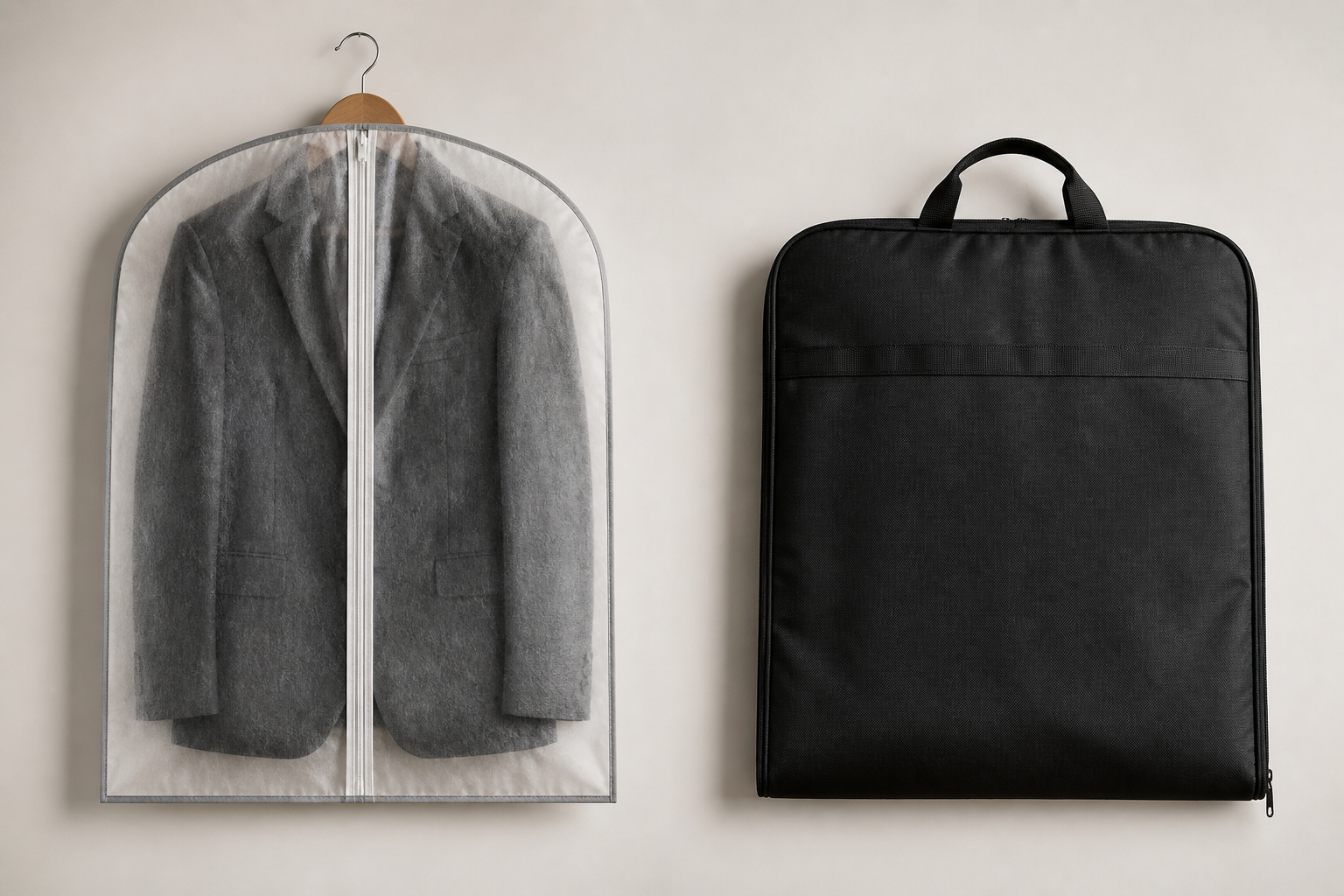
Suit Bag vs Suit Cover: Which One Should You Buy?
We get this question nearly every week. Usually from a buyer who inherited a garment bag program from a colleague, or a shop owner who ordered the wrong one once and wrote it off as a loss. Both products look similar on a spec sheet. They are not the same thing.
A suit cover hangs. A suit bag carries. That is the difference in one line, and it decides everything else — the material, the zipper, the handles, even how you fold the garment inside.
Why Do Both Products Exist?
The cover came first. Tailors and dry cleaners needed something to sit over a suit on a rail. Dust in the back of a shop is a slow killer. It settles into the weave, dulls the color, and before long a jacket looks ten years older than it is. A cover stops that.
The bag came later, when people started moving suits instead of storing them. A folded suit in a suitcase comes out looking like a used napkin. So factories cut the cover pattern shorter, added handles and a full-length zip, and called it a bag.
That history matters. It tells you what each product is engineered for. Try to make one do the other’s job and you will find the weak spot within a month.
Who Should Buy a Suit Cover?
Three types of buyer, in the order we see them:
Dry cleaners and laundry services. Covers protect finished garments on the rack and on the way out the door. Most of our dry-cleaning customers run non-woven covers at 60–80 gsm with a clear PEVA front panel, so the customer sees the garment before leaving. The unit price is low enough to treat covers as semi-disposable, and they survive a few round trips without complaint.
Retail shops and boutiques. Display garments stay dust-free, and the cover doubles as packaging. A printed logo on the front panel does more selling than any shop sign. We silk-screen names, hot-stamp monograms, and embroider store crests — whatever the shop wants, in runs as small as 500 pieces.
Hotels. Wardrobe covers in guest rooms. This is a volume game. We ship 5,000 to 20,000 covers at a time for hotel groups, usually in PEVA with a clear front so a guest can see the garment without opening anything. Some chains ask for the 100–130 cm range; suites with full-length wardrobes get the long ones.
If your garment sits on a rail for weeks, you want a suit cover.
Who Should Buy a Suit Bag?
The bag earns its keep the moment a garment moves. Three situations, three different bags:
Business travel. A bag folds flat into a suitcase. The suit goes in on its hanger, the zip closes, and the jacket arrives without creases across the back. Most travelers pick a 100–120 cm bag with one handle and a full-length zip. Some want a shoe pocket inside. That is a standard option for us.
Garment delivery and valet services. This is where the bag proves itself. Couriers fold the bag in half, sling it over a shoulder, and the zip has to survive hundreds of cycles. We use #5 zippers and double-stitched handles here. A cheap #3 zip dies in weeks, and you will get the returns to prove it.
Weddings and events. Suits, dresses, and uniforms travel once, but they have to arrive perfect. A padded bag at 150 cm plus keeps a gown safe on the back seat of a car. Bridal shops order these in black or ivory with a printed logo, and sell them to customers as take-home protection.
If your garment moves, order custom suit bags. If it sits, order covers. Choose by movement, not by price.
Material Differences That Actually Matter
You will see three materials in quotes, and they are not equal:
- Non-woven, 60–100 gsm. Breathable, light, and the best surface for printing. It is our default for covers and mid-range bags. At 80 gsm it survives a season of shop use. At 100 gsm it survives a lot more — we use it for bags that couriers carry daily.
- PEVA. Clear, waterproof, and cheap. It shows the garment through the bag, which is why retail and hotels love it. Downside: it does not breathe. A damp suit stays damp, and damp plus dark equals mold. Never store wet clothes in PEVA.
- RPET, recycled polyester. Made from recycled bottles and GRS-certified. It costs 15–20% more than virgin non-woven. More brands ask for it every quarter. If your customers audit your sustainability claims, RPET is the safe answer.
What Size Do You Need?
Measure the garment on its hanger, from the top of the shoulders to the hem. That one number decides the bag:
| Garment | Length on hanger | Bag size |
|---|---|---|
| Dress shirt | 70–85 cm | 90 cm |
| Suit jacket | 95–105 cm | 100 cm |
| Long coat | 120–135 cm | 130 cm |
| Gown / wedding dress | 140–160 cm | 150 cm+ |
Add 5–10 cm of slack. A tight bag crushes the shoulders and strains the zipper. An oversized bag flaps around the rail and looks sloppy on a shop display.
What Goes Wrong When You Pick Wrong
We see the same three mistakes in order forms:
Cover used as a carry bag. The handle rips on the first trip. Covers are not built for weight. The non-woven stretches at the hook hole and the hanger pokes through by the third week.
Bag used for storage. The fold line at the waist sets in after a week. Suits folded inside a bag for a month come out with a crease across the middle that no steamer fully removes.
Wrong size. A 100 cm bag on a 130 cm coat means the hem sticks out, collecting dust — which defeats the whole point of the cover.
None of these are disasters. They are wasted money, and they are all avoidable with the right product.
What We’d Tell You If You Called Our Factory
Our rule of thumb: stock covers, sell bags.
Run a shop or a dry cleaner? Keep a stack of 80 gsm non-woven covers for everyday protection. Order 500 pieces and the unit price drops to a point where you can give covers away with every garment. That is what our retail customers do, and it works.
Building a brand? Go for the bag. A printed bag with your logo travels further than any cover. Put it on your website with size options and let buyers choose. The customization page shows what we offer — hot stamping, silk screen, embroidery, three zipper grades, and gsm choices from 60 to 120.
On logistics: samples take 7 days. Production runs 20–30 days, depending on quantity and finish. We quote FOB, CIF, or DDP, and the MOQ is 500 pieces. Most factories in this trade want 2,000, so that number matters to small buyers.
One last thing. People ask which we would pick for ourselves. Nine times out of ten the answer is both — a cover for the wardrobe, a bag for the road. They do different jobs, and the job decides the product.
Want a quote for either one? Get a quote and tell us what the garment is. We will tell you what fits.