


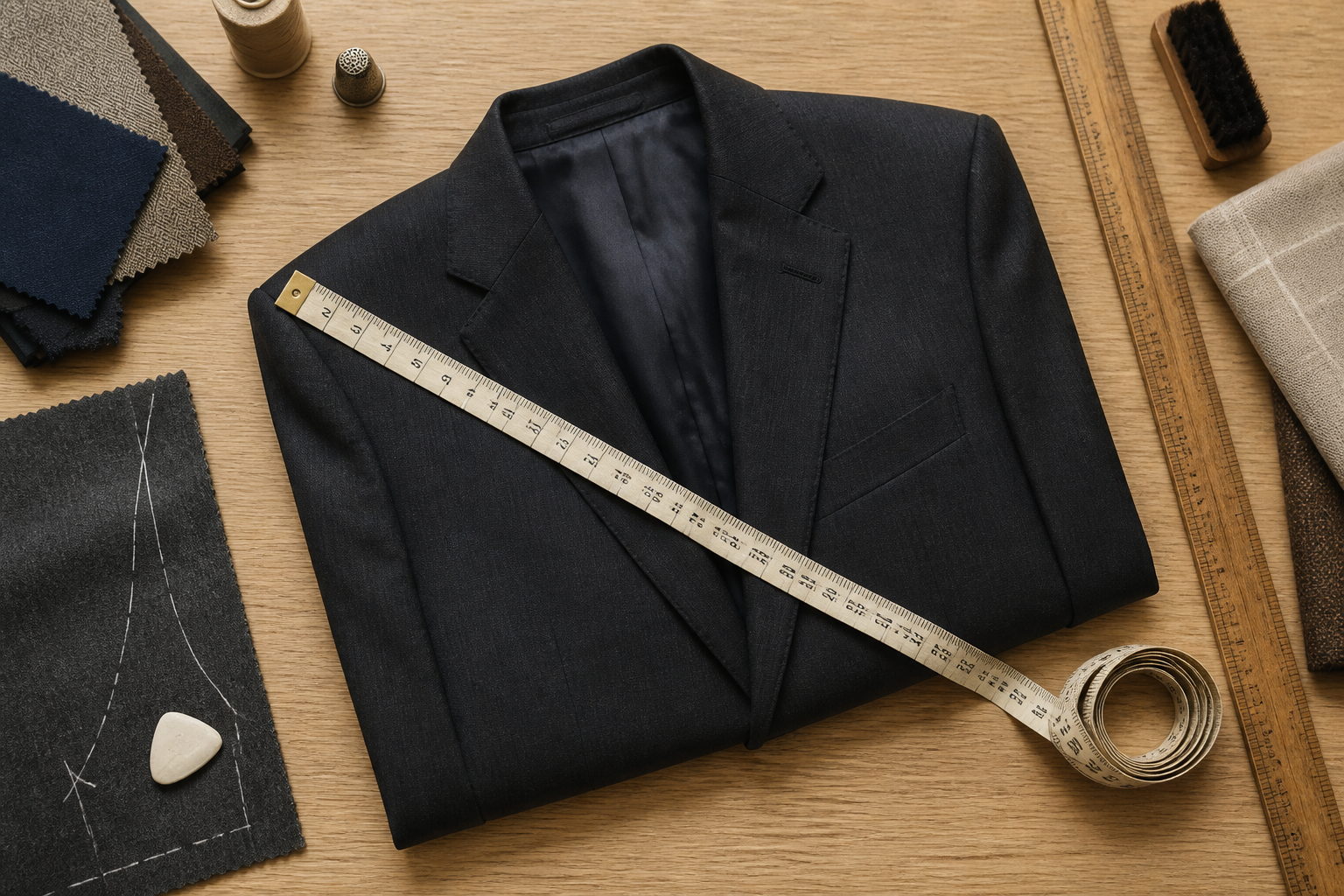
How to Measure a Suit for a Garment Bag (Size Guide)
“Which size bag fits a 52L suit?” — we get variations of this every week. It is the wrong question, honestly. Suits are not measured like luggage. One number decides the bag: the length from the top of the shoulder to the hem, measured while the garment hangs.
Get that number right and the rest is easy. Get it wrong and one of two things happens: the suit arrives crushed, or the bag looks empty and sloppy on the rail. Neither looks good in front of a customer.
The One Measurement That Matters
Hang the jacket on a hanger. Smooth the shoulders with your hands — no bunching at the collar. If the suit has shoulder pads, make sure they sit flat before you measure.
Measure from the top of the shoulder seam, straight down the center back, to the bottom hem. That number, in centimeters, is your bag length. Round up to the nearest 10 cm.
Why the center back? Because that is how a garment hangs naturally. Front measurements lie. Lapels and vents make the front look shorter than the back, and a suit cut for a fuller chest drapes even more. If you measure the front, you will order a bag 5–10 cm too short.
Two people make this job easier. One holds the tape at the collar, the other reads the hem. A single person trying to hold a tape, smooth a shoulder, and read a number usually ends up measuring the front by accident.
What about the trousers? They do not change the bag size. Trousers fold over the hanger bar or sit flat in the bottom of the bag, and a 100 cm bag swallows them without trouble. The jacket decides the size. The only exception is a full formal set with tails — that hangs like a long coat, so measure it as one piece.
Do Chest and Shoulder Measurements Matter?
For most garments, no. Standard bags are built around a hanger hook and a 45 cm hanger width. A suit jacket in sizes 46–54 fits the same bag. The length is the only variable that changes between sizes.
The exceptions: a size 60+ jacket, a riding coat with heavy shoulders, or a wedding dress with a full skirt. For those, order a bag 5 cm wider than standard and mention the shoulder width in your order notes. We cut widths from 40 to 50 cm on request. Custom sizing is standard practice for us, not a special favor.
One more thing worth knowing: the hanger matters too. A thick wooden hanger at 50 cm wide will not fit a bag cut for a 45 cm wire hanger. If your store uses heavy hangers, tell us. We adjust the bag width to match.
The Size Table
Use this as a starting point, then measure your actual garment and compare:
| Garment | Length on hanger | Bag to order |
|---|---|---|
| Dress shirt | 70–85 cm | 90 cm |
| Suit jacket (two-piece) | 95–105 cm | 100 cm |
| Long coat / trench | 120–135 cm | 130 cm |
| Wedding dress / gown | 140–160 cm | 150 cm+ |
| Thobe | 135–160 cm | 150–165 cm |
The 90 cm bag also covers short jackets and blazers. The 100 cm bag is the best seller in our line — it fits roughly 80% of men’s suits. The 130 cm and up sizes are the ones buyers forget to check, because a suit is not a coat, and a coat is not a gown.
When the Garment Runs Longer Than a Suit
Coat season is where the mistakes show up. A knee-length coat at 120 cm needs a 130 cm bag, not a 100 cm bag. The hem pokes out of a short bag and collects dust on the rail — the exact thing the cover exists to prevent.
Same logic for gowns. A floor-length wedding dress at 150 cm needs a 160 cm bag, minimum, with room for the skirt to breathe. Fold it tight and the creases set in. We cut dress bags at 150, 165, and 180 cm, and most bridal orders take the 165.
The rule: garment length + 5–10 cm slack, rounded up. Never order exactly the garment length.
Thobe: The Special Case
Thobes are the garments that break the standard sizing chart. They run 135–160 cm (54–62 inches) — longer than a suit, narrower than a coat. The measurement works the same way: hang, smooth, measure center back to hem.
A thobe at 150 cm needs a 160 cm bag. The extra length matters because thobes are worn loose; the fabric drapes below the measured point once it settles. And thobe covers need to be cut wider in the body than a suit cover, or the fabric bunches at the chest.
We make a dedicated line for this: thobe and abaya covers in 150–165 cm lengths, with a wider body cut and reinforced hook holes. If you are sourcing for a Middle East market, start there.
Four Mistakes That Ruin the Fit
Measuring the front instead of the back. You will order short. Always measure center back.
Ordering exactly the garment length. No slack means the hem touches the bottom of the bag. One fold at the hem, and the crease sets. Add 5–10 cm.
Forgetting the hanger. The hook adds height inside the bag. If you measure the suit flat on a table and order that number, the bag comes out tight at the top. Measure on the hanger, always.
Mixing centimeters and inches. A 100 cm bag is not 40 inches — it is 39.4. The rounding errors stack when you convert both the garment and the bag. Pick one unit and stick to it. We cut in centimeters; tell us the garment length in cm and we will do the rest.
What Happens When You Guess Instead of Measure
We once had a customer order 2,000 “standard” 100 cm bags for a line of overcoats. The coats ran 125 cm. Every bag left the hem exposed, and the first retail complaint arrived within two weeks. The re-run cost them 20 days of production time and the freight for a second shipment.
The second most common version: someone measures the garment flat on a table, gets 135 cm, and orders a 140 cm bag. Hung on a hanger, the same garment drops to 140 cm, because the shoulders open out and the fabric stretches. The bag comes up short. Hang the garment before you measure. Every time.
That story repeats itself more often than we would like. It is always the same cause: someone assumed a “standard size” would cover the line. It does not. Measure the longest garment in your range, not the average one, and order for that.
Custom Sizes Are the Point
The chart above is our standard range: 90 to 165 cm, in 5 cm steps. But the reason to buy from a factory instead of a distributor is that you can get odd sizes. A 137 cm bag for a specific coat. A 175 cm bag for a cathedral-length veil. We cut them. MOQ is 500 pieces, samples take 7 days, and production runs 20–30 days.
Measure twice before you order. A wrong size means a re-run, and a re-run means two weeks you did not plan for.
If you are sourcing suit bags or custom suit covers for your line, send us the garment lengths. We will confirm the sizes before we cut a single sample.
Got a garment that does not fit the chart? Get a quote with the length and the fabric type. We will tell you what fits, and what it costs.