


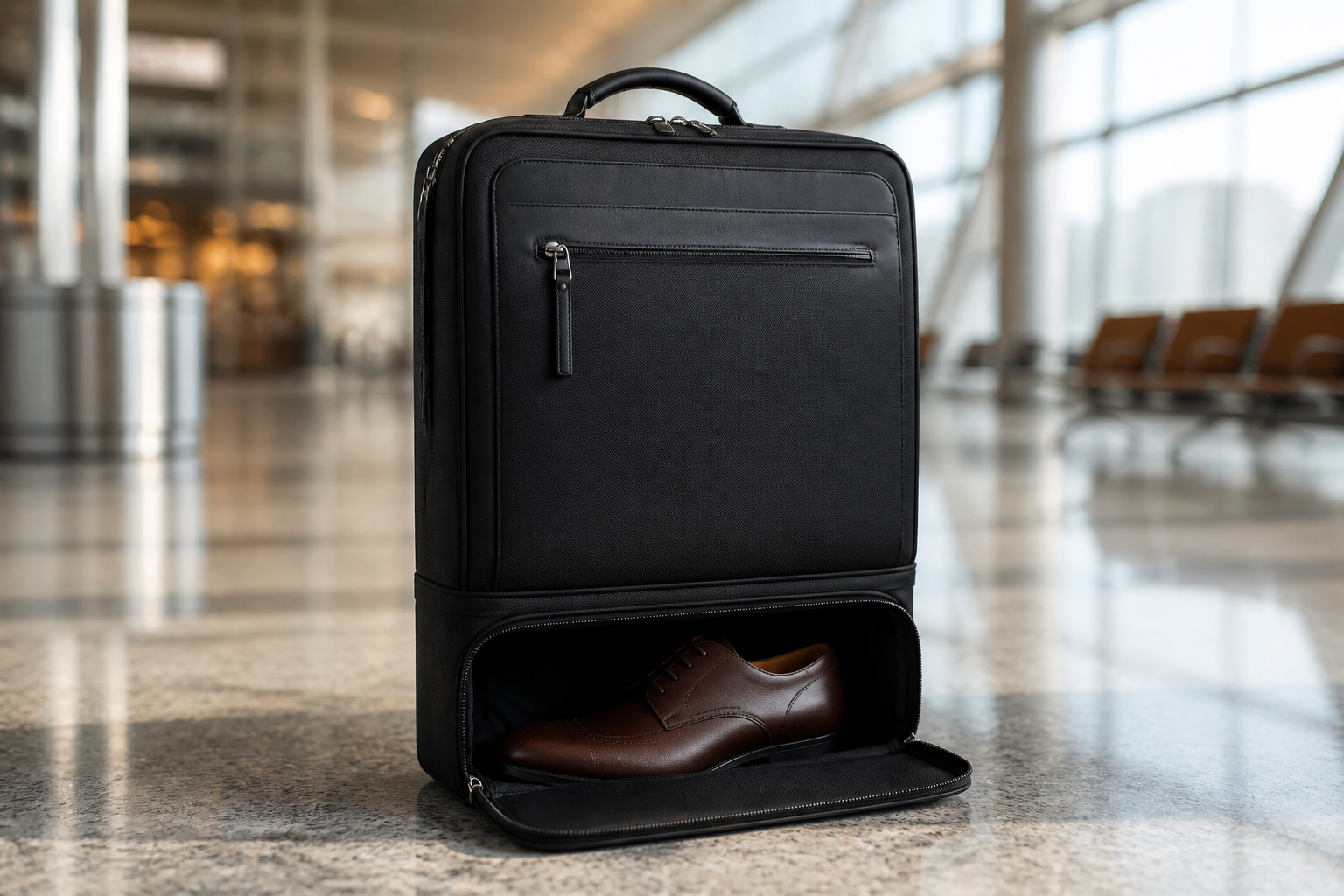
Carry-On Garment Bags with Shoe Compartments: The Traveler’s Checklist
We get the same question from business travelers every week, and honestly, most people ask it in the wrong order. They start with “which bag should I buy?” when they should start with “how much am I actually carrying?”
A suit needs one thing. A suit plus a pair of shoes needs another. Add a second pair, a belt, and a weekend’s worth of shirts, and you’re in a completely different category of bag. That’s where a carry-on garment bag with a shoe compartment earns its keep — and where the cheap ones fall apart.
Let’s walk through what actually matters, the way we’d explain it to a customer standing in our showroom.
What a Shoe Compartment Actually Changes
A normal garment bag keeps a jacket and trousers hanging straight. Add a shoe compartment and you get a second, separate space at the bottom that holds a pair of shoes without them touching the suit fabric. That sounds minor. It isn’t.
Shoes carry dirt, moisture, and an odor that fabric picks up in hours, not days. A shoe compartment with a solid divider — not just a pocket, but a real barrier with its own zipper — keeps the sole side away from the garment side. We build ours with a stiffened gusset so the shoes sit in their own pocket of space instead of pressing into the suit.
On a 45-minute flight, that might not matter. On a two-week sales trip through three time zones, it’s the difference between a suit that looks pressed and one that smells like the airport.
The Numbers That Matter in a Travel Garment Bag
We run these bags every day, so here are the numbers we actually design around:
- Total length: 100–120 cm for most carry-on garment bags. That covers a standard suit folded once. Longer cuts — think overcoats or formal wear — need 130 cm+, which usually means the bag is no longer truly carry-on.
- Shoe compartment depth: at least 12 cm, ideally 14–16 cm. Anything less and a dress shoe won’t close cleanly over the divider.
- Carry-on compliance: most airlines accept 55 × 35 × 25 cm as cabin baggage. A garment bag folds around that. If your bag is too rigid to fold, you’re checking it, and you should plan for that.
- Weight: a good travel garment bag runs 600–900 g empty. Heavier means tougher fabric, but it also eats into your luggage allowance.
What We See Break First
After ten-plus years in this trade, we can tell you what fails on cheap travel garment bags. It’s never the fabric. It’s always the hardware:
- The zipper. A #3 zipper on a travel bag is a mistake. We use #5 coils on anything that gets moved around. The shoe compartment zipper takes the worst abuse — it’s opening and closing at the bottom of the bag, in overhead bins, on hotel room floors.
- The handle attachment. A handle sewn through a single layer of fabric pulls out in about six months of weekly travel. We reinforce the handle bar with a double layer and a webbing strip underneath.
- The divider. A soft fabric divider does nothing. Shoes still press through. You need a stiffened panel.
- The hang hook. A thin wire hook bends the first time you hang the bag on a hotel door. Ours is a heavy-duty swivel hook rated for 10 kg.
Folding vs Hanging: Pick One Before You Buy
This is where buyers get confused. A carry-on garment bag does one of two things:
- Folds into thirds and fits flat in an overhead bin. The suit travels folded, which means creases — acceptable for a quick trip, not great for a gala.
- Stays straight and hangs — meaning you carry it like a garment bag and it goes in the closet on arrival. No fold creases, but you’re carrying a longer, awkward bag through the airport.
We make both. Honestly, most regular travelers choose the foldable version and accept minor creases, because the hanging version is a pain through security. If you’re traveling with a garment that cannot crease — a tuxedo, a military dress uniform — take the hanging style and plan to steam it on arrival.
How to Check the Shoe Compartment Before You Buy
When you’re comparing bags, there are three quick checks you can do in under a minute:
- Open the shoe compartment and press your hand against the divider. Can you feel it flex against the outside fabric? If yes, the shoes will press into the suit. Walk away.
- Zip and unzip the main compartment ten times. Does the pull catch? Cheap zippers catch on the fabric lip. Ours don’t, because the zipper tape is sewn flush.
- Look at the handle attachment from inside the bag. Do you see a second layer of fabric and webbing? If it’s a single stitch line, the handle will pull out.
These three checks catch the majority of problems we see when customers send us photos of bags they’ve bought elsewhere.
What We’d Spec for a Custom Travel Bag
If you’re ordering custom travel garment bags — for a brand, a hotel, or a corporate program — here’s the spec we recommend starting with:
- Fabric: 300D or 420D nylon, or a heavy non-woven at 100 gsm if you need budget-friendly
- Zippers: #5 coil on the main compartment, #5 on the shoe compartment
- Shoe compartment: 14 cm depth, stiffened divider, separate zipper
- Handle: reinforced webbing, stitched through a doubled fabric layer
- Hook: heavy-duty swivel, 10 kg rated
- Logo: screen print or foil stamp on the front panel — custom suit bags with your branding run from a 500-piece MOQ, samples in about 7 days
The Bottom Line
Buy the bag that matches how you actually travel, not the one with the most pockets. If you fly weekly with a suit and shoes, get a foldable bag with a real shoe compartment, a #5 zipper, and a reinforced handle. Check those three things, and you’ll get years out of it.
And if you’re buying in quantity — for a brand, a hotel, or a corporate gifting program — send us your spec and we’ll tell you what it costs per unit. We run custom suit bags and travel garment bags from our own factory, and we’re happy to work up a quote against your exact measurements.
Get a quote — we reply within 24 hours, usually faster.
How a Custom Travel Bag Differs from Stock
If you’ve only ever bought travel garment bags off a shelf, the custom route can feel like overkill. It isn’t, once you understand what changes.
With a stock bag, you take what the factory decided was standard — usually one size, one fabric, one zipper, one color, no logo. With a custom run, you control all of it:
- Fabric weight: 300D nylon for daily road-warrior use, 420D for premium programs, heavy non-woven when price matters more than polish.
- Colors: your brand colors, not the three colors the importer stocked.
- Hardware: we swap in the zipper, hook, and handle we know survives. You don’t have to specify #5 coil zippers — we’ll tell you what we use and why.
- Logo placement: front panel, side panel, or both. Foil stamp on nylon looks sharp; screen print is the budget-friendly default.
- Interior layout: add a second shoe pocket, a separate shirt flap, a pocket sized for a tablet or passport.
The price difference between stock and custom narrows fast once you’re past 500 units. And the bag stops being a commodity — it becomes part of how your brand travels.
Who Actually Buys Travel Garment Bags in Bulk
It’s not just frequent flyers. Across our orders, the biggest volume buyers are:
- Airlines and premium lounges — branded garment bags as an amenity for first and business class passengers. These orders run 5,000–20,000 pieces and come back every year.
- Hotels — valet and laundry programs hand guests a garment bag in the closet; the branded bag goes home with the guest and keeps the hotel name in circulation.
- Corporate gifting — companies send a travel garment bag with a logo to top clients before sales conferences. It’s practical, it’s not another mug, and it gets used on every trip.
- Tailors and suit brands — high-end suiting labels include a travel bag with their premium garments, so the suit arrives crease-free and the brand arrives with it.
Every one of those buyers has a different spec, and that’s the point — a custom program lets each of them get exactly the bag their use case demands, not a compromise.
Questions We Get Every Week (And the Short Answers)
“Will the bag fit in the overhead bin?”
A foldable 100–120 cm bag folds to roughly carry-on size. The hanging style won’t — plan to gate-check or ship it. We’ll tell you honestly which your garment needs.
“Can I fit two suits and a pair of shoes?”
Two suits folded, yes, in most of our bags. Two suits plus a shoe compartment plus a toiletry bag — you’re at the limit. Measure before you buy.
“What’s the lifespan of a travel garment bag?”
With #5 zippers and a reinforced handle, 3–5 years of weekly travel is realistic. That’s the answer we give our own wholesale customers when they ask.
“Do you make matching pieces?”
Yes — suit covers, hanging garment bags, and travel bags can be made in one program with one logo, so your brand looks consistent across hotel closet, home wardrobe, and airport.
Before You Place the Order
Send us four things and we’ll handle the rest: your garment measurements, your travel frequency, your logo file, and the quantity you’re planning. We’ll come back with a recommendation — sometimes it’s a different spec than you asked for, and it’s usually a better one.
Travel bags are a solved problem for us. Getting you the right one is just a matter of matching the spec to how you actually move.
Get a quote — samples in about 7 days, production 20–30 days after approval.