

Custom Logo Options for Garment Bags: Screen Print, Foil & Embroidery
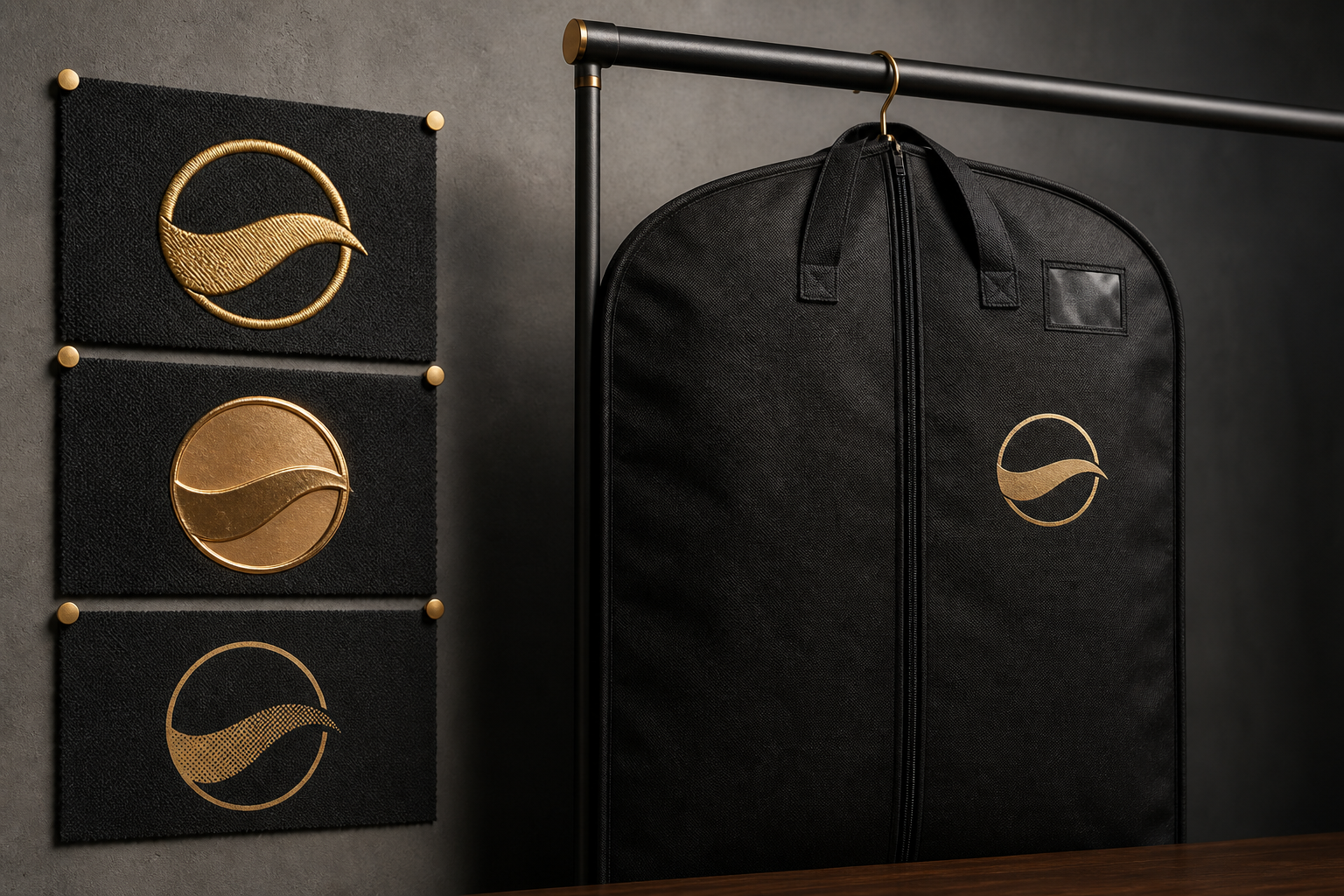
Three ways to put your logo on a garment bag. Screen print. Foil stamping. Embroidery. Each one changes the look, the per-piece cost, and the lead time.
We make custom suit bags for brands across Europe and North America. Nine times out of ten, the logo decision comes down to three questions: what fabric, how many pieces, and what the bag needs to say.
Here’s how we walk buyers through it, with the numbers we use on the factory floor.
What Screen Printing Looks Like on Non-Woven Fabric
Screen printing pushes ink through a mesh stencil onto the fabric. On non-woven 60–100 gsm — the standard material for most suit covers — it gives flat, bold colour with a soft hand feel.
It’s the workhorse option, and for good reason.
- Multi-colour is normal. Each colour gets its own screen and its own pass. Four or five colours on one bag is routine. Large areas are no problem — we regularly print full-back panels for hotel groups.
- Per-piece cost is the lowest of the three. A one-colour logo on a 500-piece order adds pennies per bag. At 5,000 pieces it’s barely a rounding error.
- One-time plate fee per colour. Expect roughly $30–80 per screen, depending on print size. You pay it once, and it stays on our shelf for reorders.
Ink choice matters too. Water-based ink is our default — it bonds into the fibres, stays soft to the touch, and passes OEKO-TEX. Plastisol sits thicker and brighter on dark fabric, but it has a rubbery feel and cracks after heavy folding. For most garment bags, water-based is the right call.
Two limits worth knowing. Fine details get muddy, because non-woven has a visible texture — tiny text under 1 cm won’t hold a clean edge. And the ink sits on the surface, so heavy abrasion wears it over years of use. For a bag used twice a week, that’s rarely a problem.
Foil Stamping: The Metallic Finish That Reads “Premium”
Foil stamping presses a heated die into metallic foil, transferring it onto the fabric. Gold, silver, copper, rose gold. One metallic colour per pass, no gradients, no half-tones.
The result is flat, slightly raised, and catches light in a way ink can’t. It reads expensive before anyone reads the name.
- Best on dark fabric. Black, deep navy, coffee brown. The contrast sells the effect.
- Best for small to medium logos. A monogram, a crest, a short wordmark. Large foil areas look heavy and cost more, because the die is bigger.
- One-time die cost, roughly $40–100. The foil itself is cheap per bag.
- Same lead time as screen print. The die takes a few days, then it’s a standard run.
Foil also combines well with print. A printed logo in white with a gold foil outline costs barely more than foil alone, because the die does the same work. We see this on hotel covers and tailor gift sets.
We see foil on hotel bags, high-end tailors, and gift sets. If the bag is part of a premium unboxing, foil usually wins.
Embroidery: Built to Last on Cotton and Canvas
Embroidery stitches the logo in thread. Raised, textured, and it lasts as long as the fabric it’s on.
It’s also the pickiest of the three.
- Fabric matters most. Embroidery shines on cotton, canvas, and twill. On lightweight non-woven below 90 gsm it distorts the fabric and can tear it — we steer customers away.
- Dense logos need dense stitching. A typical chest logo runs 7,000–12,000 stitches. Small text under 8 mm loses definition; keep lettering simple.
- Colour costs time. Every thread colour is a changeover. Three colours is fine, five is slow, and slow means expensive.
- One-time digitizing fee, roughly $25–60. That converts your artwork into a stitch file. It’s stored, so reorders don’t pay again.
- Highest per-piece cost of the three. You pay for machine time.
When do we recommend it? When the bag is cotton, and when the customer keeps it for years — the kind of bag a tailor gives with a made-to-measure suit.
Placement is worth deciding early. Chest height, bottom corner, or along the seam — each needs a different digitized file, and the digitizing fee applies per placement, not per design. A standard chest logo sits around 8–10 cm wide. Keep it there, and reorders stay simple.
Which Process Fits Your Order? A Straight Comparison
| Screen print | Foil stamping | Embroidery | |
|---|---|---|---|
| Best on | Non-woven 60–100 gsm | Non-woven, coated fabric | Cotton, canvas, twill |
| Colours | Multi (4–5 typical) | One metallic per pass | Multi (thread) |
| One-time fee | Plate per colour, $30–80 | Die, $40–100 | Digitizing, $25–60 |
| Per-piece cost | Lowest | Low | Highest |
| Look | Flat, bold | Metallic, high-end | Raised, durable |
One more point about the table. These options aren’t exclusive. A run of custom suit covers with a foil logo outside and a woven label inside is the most common combo we ship. Mixing processes is normal, and usually cheaper than you think.
Beyond the Logo: Woven Labels, Hang Tags, Leather Patches and Boxes
The logo is the start, not the end. Four other touches do real work for brands:
- Woven labels. Sewn-in, 3–5 cm, silk or satin finish. Tiny text stays readable because it’s woven, not printed. A few cents per piece.
- Hang tags. Cardboard, printed with your brand story or care instructions. Cheap, and they survive to the customer’s hand.
- Leather patches. PU leather, foil-stamped or debossed. This is the tailor-shop look.
- Packaging. Kraft or printed cartons, individual poly bags, or rigid boxes for retail. Most of our retail-brand customers go with a printed box and skip the poly bag.
None of these replaces the main logo. They reinforce it. And they’re all easier to change between seasons than a screen-printed panel.
Plate Fees, Pantone and the Fine Print
Colour matching is where factories earn or lose trust. Send us your Pantone numbers — PMS 281 for the navy, PMS 871 for the gold — and we match the ink, the foil, and the thread to them. We keep your colour file and artwork on record, so your third reorder matches your first exactly.
The rest of the fine print, in numbers:
- Sample: 7 days. A logo sample on your actual fabric, with your actual Pantone.
- Bulk production: 20–30 days, depending on quantity.
- MOQ: 500 pieces per design.
- Shipping: FOB, CIF, or DDP. DDP is common on first US orders — one price, delivered, no surprises at customs.
- Certifications: OEKO-TEX on fabrics and inks, GRS on RPET recycled material.
We also keep your screens and dies in storage, free, for two years. Reorders skip the setup fee.
One more thing buyers ask about: mixed logos. If you run ten shops with ten names, we split the 500-piece MOQ across designs — 50 per shop per name. The unit price sits a step higher, but you avoid ten separate small orders with ten separate setup fees.
Ready to see your logo on a real bag? Send us your artwork and Pantone numbers, and we’ll put a sample in your hands within 7 days. Get a quote on the customization page — it takes two minutes, and we reply within one business day, usually faster.