


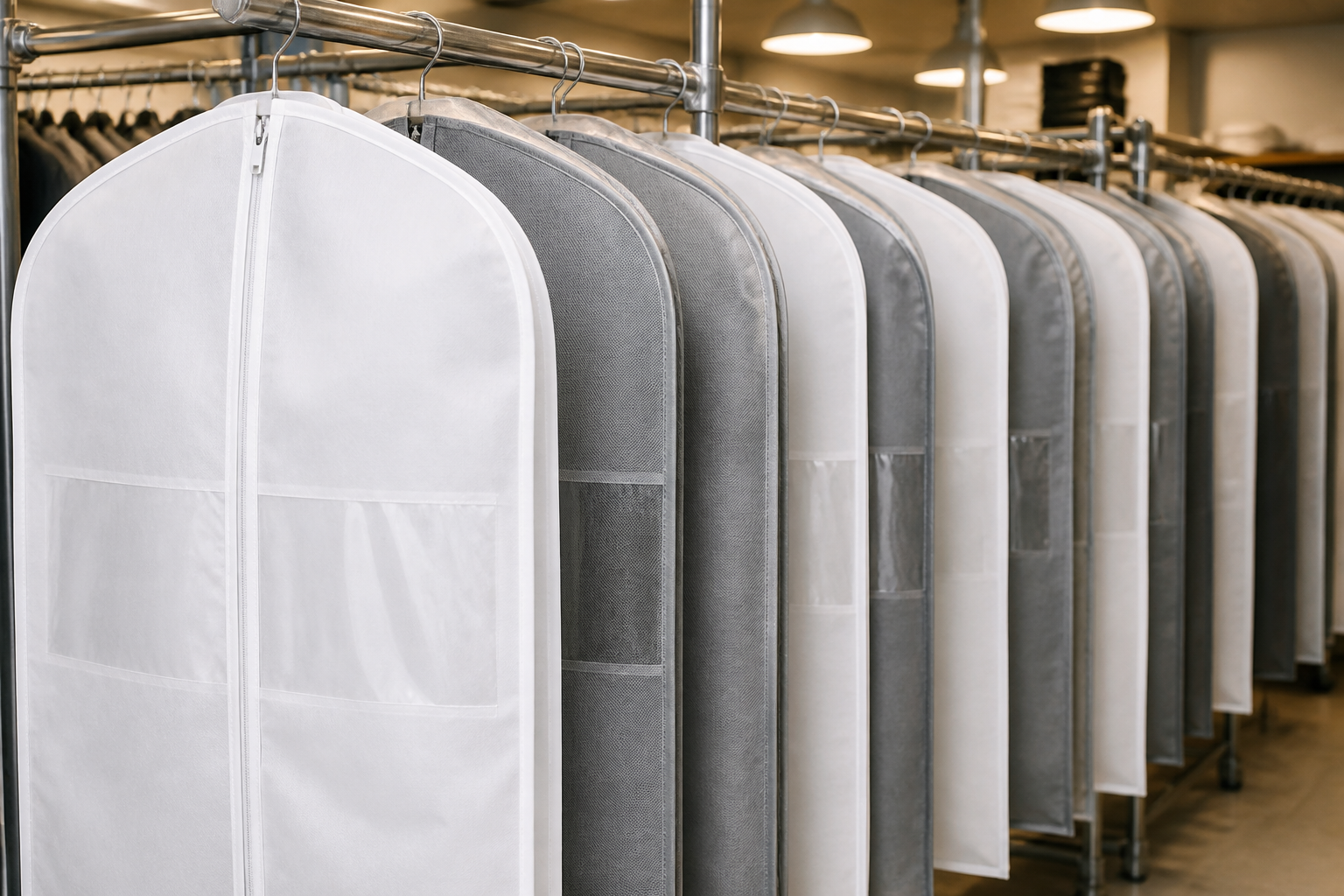
Garment Bags for Dry Cleaners: A Buyer’s Guide to Bulk Ordering
Dry cleaners go through bags the way kitchens go through gloves. Fast, and constantly.
We’ve supplied custom suit bags to dry cleaners, laundries, and hotel chains for over a decade. The buyers who do well order once, set a reorder cycle, and stop thinking about bags. The ones who struggle buy the cheapest option, watch it fall apart, and reorder monthly at worse prices.
This guide covers what actually matters in a bulk order: material, size, printing, and how many bags to buy at once.
Where Do Your Bags Go Every Week?
Track a bag for a week in a busy shop, and the numbers become obvious.
A dry cleaner processing 200 orders a day hands out 200 bags a day. Some walk out with customers — they assume the bag is theirs, and half the time they’re right. Some hit the bin with the hanger. Some come back with ripped handles.
That’s the first cost of the bag: it’s disposable, and it’s gone on day one.
The second cost is quieter. The bag is the last thing your customer touches before they leave, and it travels to their wardrobe. A bag printed with your name is walking advertising — or walking proof of a shop that doesn’t care. We’ve seen reorder rates move on this alone, though we can’t prove it in a spreadsheet.
Take a real example. A shop near us in a mid-size European city runs 180 orders a day in season. They bought 40 gsm bags once, at a price that looked great on paper. Six weeks later they were ordering again, plus paying for a rush delivery. The second order cost more than the 80 gsm bags would have cost in the first place.
The fix is boring and reliable. Buy a bag that survives ten trips. Print it properly. Order enough that you never run out.
Why 60–80 GSM Non-Woven Is the Sweet Spot
Non-woven polypropylene is the standard material for garment bags, and the weight decides everything.
- 40 gsm tears. The handle gives out in days, and the seam splits at the fold. False economy.
- 60–80 gsm holds. Ten trips, twenty trips. The bag keeps its shape, and the print stays clean.
- 100 gsm and up is hotel tier: heavier, more expensive, and more than most retail dry cleaners need.
The price gap between 40 and 80 gsm is a few cents per bag. The gap in complaints is not. We tell buyers to start at 80 gsm and step down only if their margin genuinely can’t take it.
One option worth knowing: RPET, recycled polyester with GRS certification. If you supply hotels or chains that report sustainability, it changes the conversation with their procurement team.
Sizing: Suits, Dresses, Coats and the Odd Lengths In Between
Size is where most first orders go wrong. Buyers order one size and hope it fits everything. It won’t.
- 90 cm: shirts, blazers, short jackets.
- 105 cm: the workhorse. Suits, trousers, most everyday orders.
- 120–165 cm: dresses, gowns, coats, thobes.
The rule we give every dry cleaner: stock two sizes, not five. A 105 cm bag for the rack and a 140 cm bag for long items covers 95% of your orders. Five sizes means five SKUs, five reorder points, and a shelf full of sizes nobody picks.
Measuring is simple: hang the garment, measure from shoulder seam to hem, add 5–10 cm. A 110 cm suit on a 105 cm bag strains the zip every time. When in doubt, size up — a slightly long bag looks fine on a rack, a short one looks wrong and can crush the shoulders.
Our suit covers range runs 90–165 cm, and you can mix sizes in one order with a single MOQ across the lot.
Print Now or Brand Later? The Logo Question
Most dry cleaners brand the bag on the first order, because buying unbranded means paying setup twice. A one-colour screen print of your name and tagline is one plate, one pass, pennies per bag.
Two upgrades worth considering:
- Foil stamping — gold or silver metallic. Fits a formal or high-end positioning, same lead time as screen print.
- Two-colour print — logo plus a phone number or address line. Costs a little more, saves you printing stickers.
We keep your artwork and Pantone numbers on file. Your third reorder in year two matches your first order in year one, because the plates never change.
Why Dry Cleaners Print Customer IDs on Bags
Here’s the detail that separates dry cleaners from laundries: numbers.
Hotels want room numbers printed on both sides. Retail shops want customer numbers. Both do it for the same reason — sorting time.
A numbered bag means staff never guess. The rack stays organised, orders find their way back, and the customer gets the same bag they dropped off. Small thing, but customers notice it.
- Both sides printed, one screen, no extra setup.
- Barcodes print fine on non-woven, if you track orders digitally.
- Number ranges: keep the same range across reorders, or start fresh each season — just tell us before we print.
Bulk Ordering: MOQ, Tiered Pricing and Reorder Cycles
Numbers first, because this is what buyers actually ask about:
- MOQ: 500 pieces per design. Below that, setup costs eat the unit price.
- Sample: 7 days. Bulk production: 20–30 days, depending on quantity.
- Tiered pricing — the unit price drops as quantity rises:
| Quantity | Price per bag, 80 gsm, one-colour print, 105 cm |
|---|---|
| 100 | $0.45–0.60 |
| 500 | $0.32–0.42 |
| 1,000 | $0.28–0.36 |
| 5,000 | $0.22–0.30 |
Indicative numbers, not a quote — prices move with gsm, size, and print area. The shape of the table is the point. The biggest jump happens between 100 and 500 pieces, and it usually pays for the extra storage space.
Reorder cycles: most shops reorder every 2–3 months. Chains reorder quarterly. Whatever your cycle, keep a 10–15% buffer in the back room. A stockout forces an expensive small order at the worst possible time.
Shipping terms matter more than they look on paper. We quote FOB, CIF, or DDP. For first orders from the US and Europe, DDP is the least surprising: one price, delivered to your door, customs handled. Ask for the DDP number first — it makes budgeting painless.
How Many Bags Should You Order at Once?
Do the arithmetic before you ask for a quote.
- Average daily orders. If the counter does 200 orders a day, that’s 200 bags out the door.
- Multiply by 10 days of operating stock. 200 × 10 = 2,000 bags.
- Add 5% for damage and loss. Round up to 2,100.
That lands you in the 1,000–5,000 tier, where the unit price is near its floor. Ordering 500 at a time because “we’ll reorder soon” costs more per bag, more shipping, and more admin, every single time.
Bigger is better, up to the point where bags sit in storage for six months. If you’re there, fix the reorder cycle instead of chasing the price break. Or ask us to hold your stock at the factory — we can stagger production and ship in two batches on one order.
The sample step is cheap and fast: 7 days, and we print your logo on the exact gsm and colour you plan to buy. Send us a bag you like from a competitor, and we’ll match the spec or beat it. That comparison costs nothing, and it prevents most of the mistakes in this guide.
Tell us your daily volume and what you pay per bag now. We’ll size the order, put a sample in your hands in 7 days, and keep your artwork on file for the next reorder. Get a quote on the customization page — one business day reply, usually faster.