

Bulk Suit Covers for Clothing Stores: Sizing, MOQ and Pricing
A clothing store owner in Leeds emailed us last month with three questions. What size covers should I order? How many? And what does it cost per piece?
That’s the whole job in three questions. I’ve been making suit covers for stores since 2009, and the honest answer is: it depends. On your stock, your rail space, your budget. Here’s how we walk a store through it.
What sizes should your store actually stock?
Most buyers think one size fits all. It doesn’t.
Suit covers run from 90 cm to 165 cm. A standard jacket-and-trousers suit wants 100–110 cm. A long coat or overcoat needs 140 cm. Evening gowns and maxi dresses go to 165 cm.
Width matters too. A 50 cm wide cover suits a slim blazer. A 60 cm width leaves shoulder room, so heavy wool suits don’t crush on the rail.
For a typical menswear store, we’d split an order like this:
- Short jackets and blazers: 100 cm covers, about 30% of the order
- Regular suits: 110–120 cm, about 50%
- Long coats and overcoats: 140 cm, about 20%
Change the ratio to match your stock. A store heavy on tailoring flips it. A store selling mostly casual blazers can drop the 140 cm size and save freight.
Stock three lengths and you cover nine out of ten garments on your rails.
How many covers does a store actually need?
Count your garments. That’s the starting point.
A retail floor showing 400 suits, with 200 more in back stock, needs about 600 covers. But most stores don’t buy that way. They start with 200–500 pieces, see how the sizing works, and reorder within two months.
We encourage that. First order small, learn your ratio, then commit to a bigger tier.
One more thing: add a buffer. Staff lose covers, covers tear, new stock arrives. Ten percent over your garment count is cheap insurance. 500 garments, order 550.
MOQ: what you can order and what it costs
Straight answer: our standard MOQ on non-woven covers is 500 pieces. PEVA covers, 1,000. But we’ll take 100 if you accept a setup charge.
The setup charge covers the cutting and the printing plates. It’s one-time, usually $60–$120 depending on the print. After that you buy at tier prices.
Price breaks on a standard 110 cm non-woven cover, 60 gsm, with a clear PEVA window:
| Quantity | Price per piece |
|---|---|
| 100 pcs | $0.95 |
| 500 pcs | $0.72 |
| 1,000 pcs | $0.58 |
| 5,000 pcs | $0.44 |
Those are plain covers with a hanger hole and a snap button. Printing and windows move the number.
What actually moves the price
Four things, in order of impact.
Material weight first. 60 gsm non-woven is the workhorse. 80 gsm feels denser and holds its shape longer. 100 gsm is what hotels and higher-end menswear stores ask for. Each step up adds roughly $0.06–$0.10 per piece.
The window comes second. A clear PEVA window adds about $0.05. Stores like it because staff read the garment inside without opening the bag. On a rail of forty identical black suits, that saves real time.
Printing third. One-color silkscreen runs $0.02–$0.05 per piece. Hot stamping, the foil look, $0.06–$0.12. Embroidery, $0.20–$0.35. On a 1,000-piece order, hot stamping your logo costs about $100 extra. Most stores say yes.
Packaging last. Loose covers ship in bundles of ten with a paper band. Individual polybags add $0.03–$0.05 per piece. For stockroom use, skip the polybags.
Do the math on a first order
Say you’ve got 300 suits on the floor and 150 in stock. That’s 450 garments. Add the ten percent buffer and you land at 500 covers.
500 covers at $0.72 is $360. One-color logo at $0.03 a piece adds $15. Sea freight from Ningbo to London on 500 pieces, consolidated, runs $40–$60. Total: about $420 delivered to your door.
Now compare that to retail boxes of ten at $1.50 each from a local distributor. That’s $675, with no logo. You save a third, and the covers carry your brand.
Multi-store chains buy 5,000. That tier sits at $0.44 plus print. Freight works out to roughly $2.50–$3.50 per CBM on a consolidated shipment. We quote FOB, CIF, or DDP — most EU and US buyers take DDP and let us handle the customs.
Non-woven or PEVA: pick your material
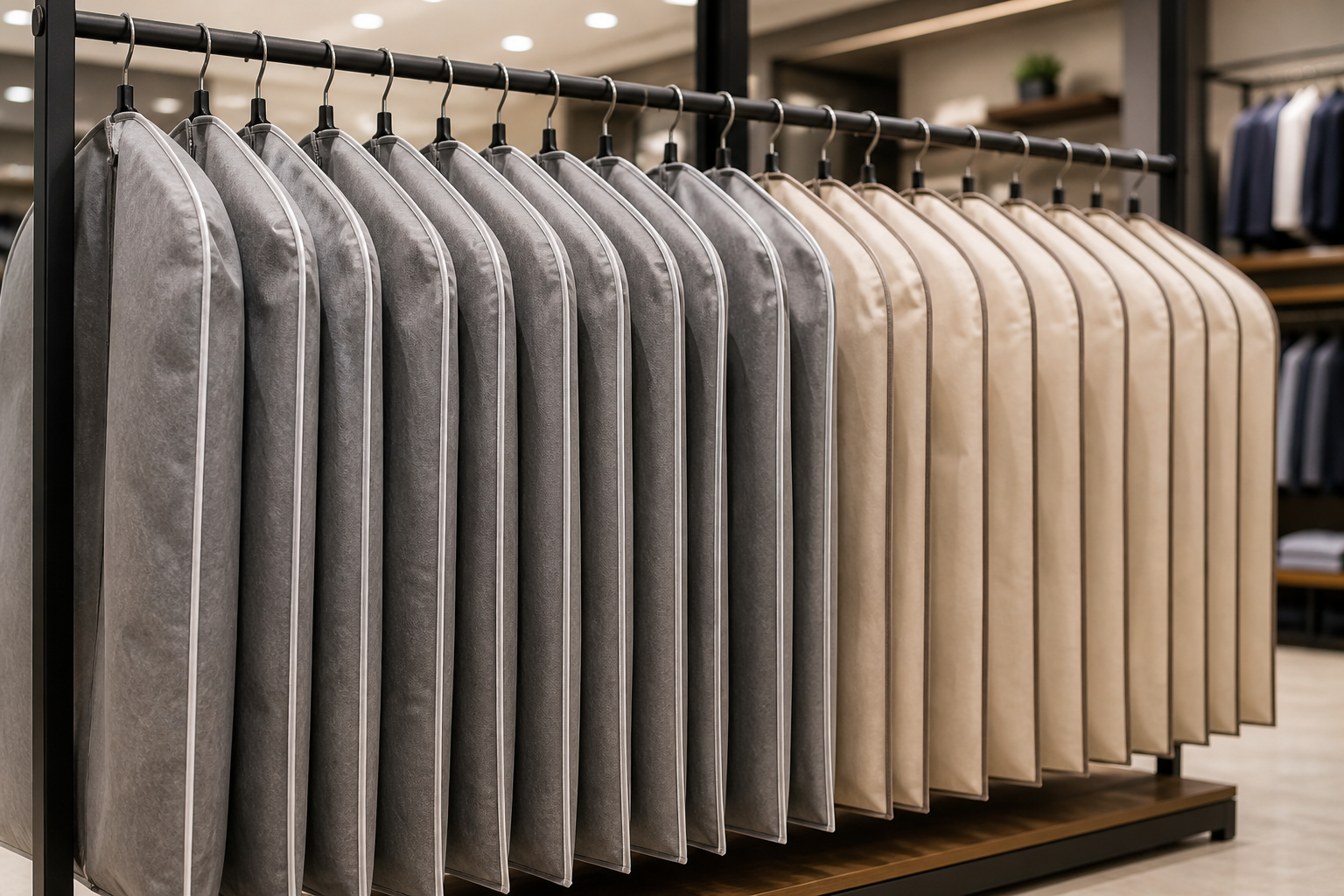
Most store covers we ship are non-woven, 60–100 gsm. It breathes, it prints well, and it’s opaque — the garment stays private until it hits the floor.
PEVA is the transparent option. You see the suit without opening the bag, and it shrugs off dust and light moisture. Cost runs $0.10–$0.20 more per piece, and it’s what buyers choose when the cover itself is part of the display.
The store standard is a hybrid: non-woven body, clear PEVA window at the chest. It’s what we quoted in the table above, and it’s what nine out of ten store orders end up as.
Two more choices worth making up front. The hanger opening: a simple hanger hole or a metal hook. The hook adds about $0.05–$0.08 but holds heavier suits without tearing the fabric over years of use. And the seam: we double-stitch the main seams on all store orders. Single-stitch saves $0.02 a bag and fails on the rail. We don’t offer it for a reason.
What stores get wrong
We see the same mistakes year after year.
Ordering one length for everything. Then the overcoats hang half-exposed, and the buyer is back in our inbox.
Skipping the print. A logo tells your staff which garments are covered, and it looks sharp when suits move from stock to floor. It costs pennies per piece. Skip it, and you’re the only store on the high street with plain white covers.
Chasing the cheapest gsm. 60 gsm is fine for most retail stock. It won’t take five years of heavy handling the way 100 gsm will. Decide the lifespan you want, then pick the weight.
Forgetting the hanger slot. Make sure your covers have a reinforced hanger hole or a metal hanger hook. Ten years ago we shipped a batch without it. Store staff cut holes with scissors. We never made that mistake again.
Timing: plan ten weeks out
Sampling takes 7 days. A confirmed order runs 20–30 days in production, depending on quantity and print. Sea freight adds 25–40 days to Europe, 15–25 to the US.
Add it up and you should order ten weeks before you need the covers. Do that once, and reorders are painless — plates and patterns stay on file.
One calendar note: Chinese New Year shuts every factory in our region for two to three weeks, usually late January to mid-February. Order before mid-January if you want covers for the spring season. Miss it, and you wait.
And one habit worth breaking: buying from a local distributor out of habit. Wholesale prices you see locally carry a 40–60 percent markup over factory pricing. Above 500 pieces, with the lead time planned, direct import wins almost every time.
You don’t need the first order to be perfect. Get the sizing right, get the logo on, and scale up as the numbers work. That’s how every repeat buyer we have started.
If you want unit prices for your mix — sizes, quantities, print — send us your list on the customization page and we’ll come back within two working days. And if your store wants custom suit bags for travel or higher-end lines, we build those too.